JDL Builders LLC

     1608 So Kanner Hwy   

Stuart , Fl  34994

To contact us:

Phone: 772-260-5049

Fax: 888-628-2862

E-mail: john@jdlbuilders.com


HOME

PHOTOVOLTAICS

PRESS RELEASES

GALLERY

SOLAR PROJECTS

LINKS

ELECTRICITY FROM THE SUN!     


Electricity from the solar roof is produced in direct current (DC) and has to be “converted” with an “inverter” to alternating current (AC) which is the standard household current.  The system feeds electricity back into the public utility grid (FPL in this case) and then generates a dollar for dollar credit to your utility account every minute of every day that the sun shines on your solar roof!   What a concept!


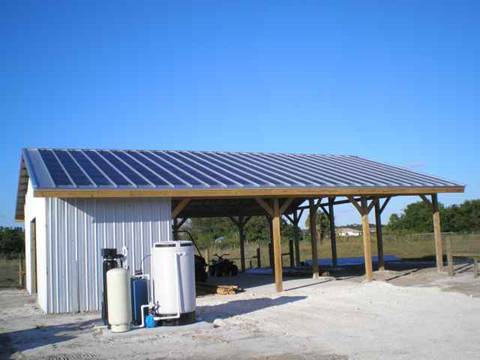
Uni-Solar PV-136  -  18 panels @ 136 watts ea.

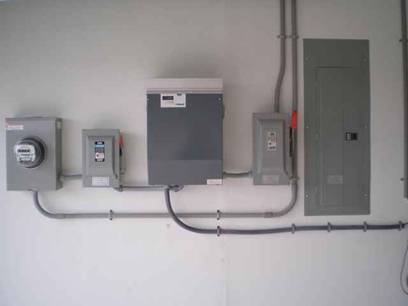
PVP2500 - 2500 watt inverter by PV Powered       

Conversion equipment situated in garage

Tuesday, March 4, 2008

New rule lets consumers sell back power

South Florida Business Journal

Florida's Public Service Commission on Tuesday ratified a rule that allows users of renewable energy generation techniques, such as solar power, to offset the costs by selling the excess power back to the utility.

The PSC said the rule also expands the size of eligible systems from 10 kilowatts to 2 megawatts, expands the type of eligible systems from solely photovoltaic to all renewable technologies, and expedites interconnection of customer-owned renewable generation.

"This rule is expected to increase the development of renewable generation in Florida, which will enhance fuel diversity and reliability," PSC Chairman Matthew M. Carter II said in a news release. "Customer-owned renewable generation also effectively acts as a conservation measure by reducing the amount of electricity purchased from utilities."

Bruce Kershner, of the Florida Solar Energy Industries Association, has said the policy, called net metering, will promote the use of solar energy and create a more robust solar energy industry in Florida. He said the old system only requires utilities pay consumers 4 cents or 5 cents for each kilowatt. Under the approved system, credits will accumulate at retail rates and continue to offset customer billing for a year, after which any remaining credit will be paid to the customer at the utility's avoided cost.

The sun blasts Earth with enough energy in one hour—4.3 x 10²⁰ joules—to provide all of humanity's energy needs for a year (4.1 x 10²⁰ joules), according to physicist Steven Chu, director of Lawrence Berkeley National Laboratory. The question is how to most effectively harness it. Thin-film solar cells may be the answer: One recently converted 19.9 percent of the sunlight that hit it into electricity, surpassing the amount converted into power by mass-produced traditional silicon photovoltaics and offering the potential to unleash this renewable energy source.

A Builder’s Dream ! ! ! ! ! !

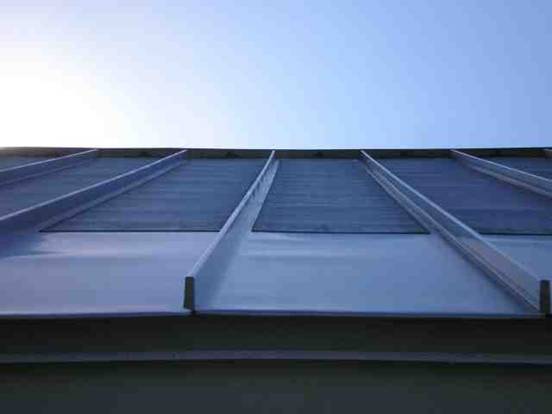
This state-of-the-art product, UniSolar thinfilm photovoltaic solar laminate, allows the builder to combine energy producing solar cells with metal roofing to produce a true BIPV “building integrated photovoltaic” system.   This system eliminates the objection to the “bulky, exterior panel look”,  it eliminates any worry from roof penetrations (and potential leaks!) which are necessary to mount panel brackets, etc., and perhaps most important of all,  gives assurance to high wind concerns with a Dade County product approval certification (NOA No.: 07-0803.01) when installed on a certified metal roof.  This BIPV is rated to withstand hurricane force winds up to 140 MPH!


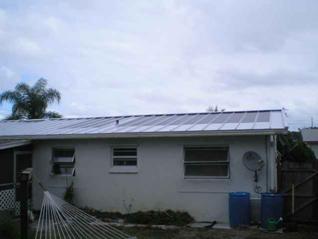
At 5pm, June 11th, 2008, my 2448 watt system was producing 2476 watts of electricity.  Total for that day was 14 Kwh.   Daily average output since April 1st, 2008, has been 12 Kwh per day.  My FPL utility bill for April/May was $24.59!      Nov/Dec was $8.43!

Tuesday, July 01, 2008

FPL gets 19 percent boost, but spread into 2009

The surging costs of oil and natural gas will make their mark on your power bill next month.

FPL rate increase chartChart: See the increases

Projected increase in your bill


August: The typical 1,000-kilowatt-hour monthly bill will increase about 8 percent, from $102.63 to $110.77.


January: The 1,000-kilowatt-hour bill will jump another 9 percent to $120.93, with $2.51 of the increase going for FPL's nuclear plant expansions.


June: The 1,000-kilowatt-hour bill will increase to $122.36, including the $2.51 nuclear charge and $1.43 for the West County Energy Center's Unit 1 near Loxahatchee.


Florida Power & Light Co.'s residential customers will see their monthly bills jump by a total of 19.2 percent from August through June 2009 to cover half of the $746 million in unanticipated fuel costs FPL is facing this year, state regulators decided Tuesday.


And this isn’t the end of it ! ! !


"This is one more unplanned shock that we're having to deal with," Frank said.

The rate increase doesn't factor in another $300 million fuel shortfall that FPL expects to ask the PSC to consider in November 2008. Those costs and three proposed solar-power projects could increase FPL customers' bills even more in 2009.


IT’S TIME TO START THINKING ALTERNATIVELY!


Click to watch Channel 25 interview!

Click to watch Channel 5 interview!

An Important Distinction

There is an important difference between a tax deduction and a tax credit. A tax deduction is subtracted from income before total tax liability is computed. On the other hand, a tax credit is subtracted directly from the total tax liability. This means that a deduction and a credit have very different values, with a credit being 3 or more times more advantageous to the taxpayer than a deduction. For example, a tax credit of $1,000 for someone in the 28% tax bracket is equivalent to a tax deduction of $3,571.

Commercial & Residential Tax Credits as of  Jan 1st, 2009:
For solar electric (PV) systems, the tax credit is 30% of the equipment and installation cost, with no maximum limit.


NEWS FLASH ! ! !     October 2008

Long-term Extension of Energy Credit. The bill extends the 30% investment tax

credit for solar energy property and qualified fuel cell property, as well as the 10%

investment tax credit for microturbines, through 2016. The bill increases the $500

per half kilowatt of capacity cap for qualified fuel cells to $1,500 per half kilowatt of

capacity, and adds small commercial wind as a category of qualified investment. The

bill also provides a new 10% investment tax credit for combined heat and power

systems and geothermal heat pumps. The bill allows these credits to be used to offset

the alternative minimum tax (AMT).


Long-term Extension and Modification of the Residential Energy-Efficient

Property Credit. The bill extends the credit for residential solar property for eight

through 2016, and removes the credit cap (currently $2,000) for solar electric

investments. The bill adds residential small wind investment, capped at $4,000, and

geothermal heat pumps, capped at $2,000, as qualifying property. The bill allows the

credit to be used to offset the AMT.

Uni-Solar

Solar Power Video

JDL Builders LLC